Imperia: A European Culture Story, Part 1

2026-Feb-21, Saturday 00:35
[syndicated profile] crooked_timber_feed

Posted by Doug Muir


Just north of the Alps, on the border between Germany and Switzerland, lies beautiful Lake Constance. And on the northwest shore of the lake is the lovely small city of Constance, Germany.

Constance is well worth a visit. A lot of German cities have rather bland or unattractive centers, thanks to the American and British air forces. But Constance escaped these attentions entirely, because the Allies didn’t want to risk any bombs landing in neutral Switzerland. So Constance has an unusually intact Old Town with lots of interesting old buildings, some going right back to medieval times.

Constance also has this:

Die Imperia, rotierendes Wahrzeichen von Konstanz am Bodensee und beliebte Touristenattraktion, hat bei ihrer Aufstellung im Jahr 1993 erhebliches Aufsehen erregt. (SKF)

A nine meter tall, 18 ton statue of a medieval sex worker.  She’s down at the harbor, on the lake.  She rotates once every four minutes.  Her name is Imperia.

You may reasonably ask, what?  And part of the answer is, she’s memorializing the Council of Constance, the great political-religious council that happened here 600-some years ago, from 1414 to 1417.  And you may ask again, what?

I’ll try to explain.  

Constance

Lake Constance gets its modern name from the city of Constance.  And the city of Constance is named after Constantius, a fourth century Roman emperor.

Constantius Chlorus - Alchetron, The Free Social Encyclopedia
[probably this guy, though it might have been his grandson.  it was the 4th century, stuff got confused.]

Back in the first century AD, the Romans pushed up through the Alps into what’s now southern Germany. They brought peace to the region via their traditional mix of mass murder, ethnic cleansing, and forced Romanization.  They seem to have built a bridge at Constance — the lake tapers down to a narrow neck there.  And credit where it’s due: the Romans loved nothing better than building transport infrastructure.  Bridge going north, good Roman roads going south, inevitably a town sprang up.  Later, in the 4th century when the Empire was turtling up against the ever more aggressive barbarians, the trading town built walls.  It became a border fortress, and got a new Imperial name.

(You have to work a bit to find corners of Europe that haven’t been touched by someone’s empire.  Roman, Frankish, Byzantine, Holy Roman, Ottoman, Spanish, French, Russian, British, German… ruins and roads, castles and place names, borders and battlefields.  The continent is pock-marked with them like acne scars.)

The Romans eventually departed, but the bridge and the town seem to have survived.  Certainly both were still there a thousand years later, when the Catholic Church convened a General Council there in 1414.

So is Imperia about the Roman Empire, then? 

No, not at all.  Well… not directly.

Three Popes, One Council

“And if a man consider the original of this great ecclesiastical dominion, he will easily perceive that the papacy is no other than the ghost of the deceased Roman Empire, sitting crowned upon the grave thereof: for so did the papacy start up on a sudden out of the ruins of that heathen power.”   — Thomas Hobbes, Leviathan

For a while, back in the 14th century, there were two rival Popes.  Each had his own Papal court and hierarchy, each was doing all sorts of Papal things — collecting religious dues, appointing Bishops and Cardinals, excommunicating heretics — and each was recognized by about half of Europe.  This was generally agreed to be a bad situation!  So there were several attempts to fix this problem.  They all failed, and one went so spectacularly wrong that it produced a third Pope, recognized by another couple of European countries.

At this point pretty much everyone agreed that something drastic had to be done.  So a General Council of the Church was called, with implicit power to sit in judgment on all three rival Popes.  Italy was problematic for a bunch of reasons, France was in the middle of the Hundred Years War — 

Kenneth Branagh Henry V
[Branagh or Olivier?  discuss.]

— so after some discussion it was decided to convene the Council in the small neutral city of Constance, which if nothing else was centrally located.

In Conference Decided

“A conference is a gathering of people who singly can do nothing but together can decide that nothing can be done.”  — Fred Allen

The Council of Constance is just so darn interesting.  

I’ll try not to chase too many rabbits, but here’s a thought.  In the early 15th century Europe was, in terms of global civilization, a backwater.   The Chinese were more technologically advanced, India was richer.  Asia was full of cities that were larger, cleaner, safer, and better designed than Europe’s grubby little burgs.  Heck, the contemporary Aztecs had a capital at Tenochtitlan that was bigger and nicer than anything in Europe,  and those guys were barely out of the Stone Age. 

Europe had nothing that the rest of the world particularly wanted  to buy, which meant that Europe had been running a trade deficit for literally centuries.  (This would lead to a serious economic crisis later in the century, as the continent nearly ran out of  gold and silver.)  Militarily, Europeans had been losing battles and wars to non-Europeans for a while, and this would continue for some time.  In particular, the Ottomans had just embarked on a long career of kicking Europe’s ass. Within a century, a huge chunk of the continent would be Ottoman provinces or tributaries. 

And yet.  Somewhere along the line, Europe went from “D-tier also-ran kind of lame civilization” to “planetary apex predator”. 

Why?  Why Europe? 

Some of the world’s smartest people have spent lifetimes of scholarship trying to answer that question.  Not for a moment will I imagine I can add anything useful to that great debate.  But here’s an offhand thought: there’s a short list of things that are, historically, unique or nearly unique to Europe.  One of those things? International conferences.  

The Berlin Congo Conference: Laying the ground rules for conquering Africa ( 1884) – Black Central Europe
[it doesn’t get much more European than this.]

This is probably because international conferences started as a particularly Christian thing.  The early Church was spread broadly but thinly across a politically united Roman Empire that had, for a premodern state, unusually excellent transport links.  (See earlier comment re: Romans and transport infrastructure.)  So it made sense to periodically come together: to keep doctrine and practice consistent, to resolve leadership disputes, and just generally to settle questions that couldn’t be worked out locally.  The great-grandfather of them all was the Council of Nicaea, back in 325 AD, which gave us the Nicene Creed.

The Man Who Became Santa: Who Was Saint Nicholas?
[BEGOTTEN NOT MADE HERETIC iykyk]

And there were lots more Councils, all through late Antiquity and the Middle Ages: Chalcedon, Constantinople, Lateran, Lyons.

But there’s a second line of mostly secular conferences called by Europeans to resolve international disputes: most typically to end a war, but often with a sidebar of “and let’s try to set up some sort of international order”.  And you can argue with a straight face that the Council of Constance is the takeoff point for this second line. 

Because Constance was a Church council, yes.  But it was also political in a way that previous medieval Councils hadn’t been.  It was attended by kings and dukes and counts, lawyers and professors and representatives of Imperial Free Cities — in fact, the lay attendees may have outnumbered the clerics.  It relied on the Emperor Sigismund to provide security and enforcement.  Its decisions required buy-in from the secular authorities.  Voting at the council was done by “nations” — groups of Churchmen, but sorted geographically by region within Europe.  And while Church reform and heresy were on the agenda, the overriding imperative was straight-up power politics: to resolve the Papal schism and settle the Church’s internal government.

So on one hand, Constance was just another in that long line of Church councils from Nicaea to Vatican II (1962-65).  But at the same time, it was arguably the first great multilateral peace conference.  Lodi, Westphalia, Vienna, Versailles, Yalta: Europeans have been holding these conferences for a long time.  There’s a direct line from Constance to the G-20.

— No, I’m not claiming that international conferences are what made Europe special.  I’m just noting that these secular peace-and-international-order councils really get going in the 15th century, right around the time that Europe begins its slow ascent out of mediocrity.   Almost certainly a coincidence!  Still: interesting.

Deliverables

So the Council of Constance had three declared goals, plus one goal that was undeclared but universally recognized. 

The declared goals were:

1)  Fix the whole three Popes thing.
2) Deal with heresy.  Specifically, deal with Jan Hus, who was the beta version of Martin Luther, and his followers.  The Hussites had basically taken over one European country already, and were threatening to spread.
3)  Reform the Church, which everyone agreed was spectacularly corrupt, and doing a pretty terrible job of providing spiritual guidance and moral leadership to Catholic Europe.  (This was cross-wired with (2) because the Hussites were claiming to be, not heretics, but reformers.)

The undeclared goal was

4) By asserting the superiority of a Church Council over Popes, convert the Catholic Church from an absolute monarchy to a constitutional monarchy. 

Nobody was publicly saying this was the plan, but this was totally the plan.  There had been a bunch of bad Popes already.  It was clear that giving that much power to anyone was a dubious idea to begin with, and that this was made worse by a selection process that favored ruthless conniving corrupt SOBs. 

Getting rid of the Papacy was unthinkable, of course.  But regular Church Councils to keep the Popes in check?  That seemed entirely doable.

Key Performance Indicators

They succeeded at (1) and failed at the other three. 

They did burn poor Jan Hus.  It’s a sad story and I won’t go into the details.  TLDR, they burned him, but the Hussites took over Bohemia anyway — the modern Czech Republic, more or less — and stayed in power there for over a century.  The secular rulers around them did manage to contain the Hussite heresy and keep it from spreading, but that wasn’t because of anything the Council did.

But the really consequential failures were that they utterly failed to reform the Church and they didn’t curb the powers of the Papacy.  The Church would remain horrifically corrupt, and the Popes would remain autocratic — and all too often greedy, cruel, and completely uninterested in providing spiritual or moral leadership.

It would take nearly another century for these particular chickens to come home.  But the eventual, inevitable result was the Protestant Reformation.

Ninety Five Theses
[hammer time]

By failing to fix the system, the attendees of the Council guaranteed that the system would eventually explode. 

But, really, how could they do otherwise?  Cardinals and bishops and abbots, counts and dukes and kings, priests and professors… they were all products of the system, and they were all benefiting from it.  

Somewhere, Imperia is smiling.  We’ll get back to Imperia.

One fled, one dead, one sleeping in a golden bed

So what happened to those three Popes, anyway?

Well: John, the Neapolitan Pope, was a pretty sketchy character even by the low standards of late medieval Popes.  Among other things — many, many other things — he was plausibly suspected of having poisoned his predecessor.  So the Council offered him a deal: resign, and we won’t open an investigation into these accusations.  Since an investigation would lead to a trial, and a trial would lead to a conviction, Pope John agreed and stepped down.  

But then!  John slipped out of Constance — disguised as a postman, some say.  He fled to the castle of a friendly noble, un-resigned, and declared the Council dissolved.

The Council wasn’t having it.  The Holy Roman (German) Emperor summoned an army to besiege the castle. John fled again, but the Emperor’s forces followed.  Eventually he was caught and dragged back to Constance, where they did put him on trial, and convicted him too.  He spent several years in comfortable but secure confinement.  He was allowed out once it was clear that he would behave himself, i.e. not try to be Pope any more.  

Now, one of John’s few accomplishments as Pope was choosing the Medici of Florence as his bankers.  Did you ever wonder why the Medici were such a big deal?  It’s because they were the bankers for the Papacy for almost a century.  Immense sums of money flowed into Rome from all over Europe.  All of it passed through Medici hands at some point, and of course the bankers took their cut. 

And, credit to the Medici, they used at least some of that money to become some of the greatest patrons of art that the world has ever known.  Michelangelo, Botticelli, the Duomo, Donatello, the Sistine Chapel… all that happened because of bad Pope John.

The Creation Of Adam Wallpapers - Wallpaper Cave
[“Award of a Sole Source Contract for Financial Services”, fresco, c. 1509]

When the disgraced ex-Pope eventually died, the reigning Pope didn’t want to give him a burial in Rome.  So the grateful Medici whisked John’s body off to Florence, where they gave him a nine-day funeral.  Then they built him a nice little tomb.  It was eight meters tall, marble and gilt, with Corinthian columns and a bronze effigy — you know, the usual — designed by Medici client artists Donatello and Michelozzo.   It’s still there in Florence today.

undefined
[phrases rarely found together: “Medici” and “tasteful understatement”]

Gregory, the Venetian Pope?  He cut a deal.  He agreed to resign if (1) the Council subsequently acknowledged that he had been the One True Pope all along, so that his rivals were declared schismatic antipopes, and also (2) he got a unique one-time title of “Second Most Important And Holy Guy In The Church, After The Pope”.  The Council decided this was cheap at the price, and agreed. 

So Gregory is still counted by the Catholic Church as an official Pope.  (Which means he was the last official Pope to resign the office until Benedict XVI’s abdication in 2013, five hundred and ninety-seven years later.)

Pope Gregory XII - Wikipedia
[he even got to keep the hat]

Benedict, the Spanish Pope?  He refused to resign.  But the Council went to work on the remaining countries and monarchs who were supporting him, and talked them around.  So Benedict ended up abandoned by most of his supporters.  He died a few years later, mule-stubborn to the end, isolated and mostly ignored.

That time they elected the Pope in a shopping mall

Once the Council had eliminated or sidelined the three Popes, they needed to choose a new one.  For this, they used a unique, one-time-only system of voting. Council attendees gathered into geographic “Nations”, each nation picked six guys to represent them, those six guys cast one vote.  This was an attempt to put a new, Council-based system of Pope selection in place, since the existing College of Cardinals process kept throwing up Popes who were scheming evil bastards.  

It didn’t take.  The next Papal election took place when there was no Council, so they went right back to the College of Cardinals.

Conclave movie review and analysis: Inside the Oscar-winning Vatican ...
[and they’ve kept it ever since]

But they also had the problem of where to hold the election.  Because traditionally, Papal electors are isolated, cut off from outside influences until they decide.  So they needed a building that was large, but that could be sealed off, but also handed over to the electors for some indefinite period of time. As it turned out, medieval Constance had exactly one building that fit the requirements:  the town Kaufhaus.

Today the word “Kaufhaus” gets translated as “department store”.  But the Constance Kaufhaus was a combination warehouse and retail center.  Foreign merchants kept and sold premium goods there.  It was a big building full of little shops selling luxury items.  Literally, a high-end shopping mall.

Still, needs must.  And credit to the electors: they managed to reach a consensus and elect a Pope who was, if not brilliant, at least not an incompetent, a criminal, or a monster.  Pope Martin V would rule for 13 years and while he wouldn’t do much that was memorable, neither would he poison his enemies, appoint a bunch of nephews and bastard sons to high office, run the Church into bankruptcy, or otherwise disgrace the office.  

Of course, this goes to a deep structural problem.  The Council chose a kindly mediocrity because they were afraid that a strong Pope would claw power back from Councils.  (Which is exactly what happened, a Pope or two later.)  But the Church desperately needed reform, which a kindly mediocrity couldn’t possibly deliver.  

Also, the College of Cardinals absolutely hated the idea of anyone else being involved in electing the Pope. Partly this was a status issue.  Partly it was about ambition — most Popes came out of the College, after all.  (Still true.)  But most of all, it was about cold hard cash.  Would-be Popes were often willing to pay immense bribes in order to buy votes.  Kings and Dukes would throw in more bribes to support or oppose a particular candidate.  Banks and wealthy families would coolly lend money to finance these bribes, since backing a winning Pope could mean an instant flow of massive wealth. 

This is, of course, how the Medici became the Papal bankers.  It was they who funded the election of bad Pope John in the first place.  


undefined
[Allegory of a Papal Election, c. 1480.  the winged figures represent the Medici, scattering flowers (money) as they blow the candidate to the shores of success.  the handmaiden (the Church) is about to clothe her in a robe decorated with flowers (even more money).  the candidate gazes into the middle distance, seemingly unaware.]

So reforming the electoral process would not only have been a hit to the Cardinals’ status, it would also have drastically curtailed their future income.  It’s no surprise that they weren’t enthusiastic about the new system, and abandoned it as soon as they could.

Somewhere, Imperia is still smiling.  We’ll get back to Imperia.

Everybody goes home

The Council wrapped up in 1418.  Joan of Arc would have been in first grade, if medieval French peasant girls went to first grade, which they didn’t.  She was about 10 years away from starting her brief incredible career as the savior of France.  Johannes Gutenberg was a freshman at the University of Erfurt.  He was about twenty years away from inventing the printing press. Over in England, a handsome young Welshman named Owen Tudor was hanging around the court of King Henry V.  In a few years, King Henry would die of dysentery.  His widowed Queen would marry handsome Owen.  Their grandson would be the first Tudor king of England, and their descendants are sitting on the British throne today. 

Jan van Eyck was in his twenties, just getting started on his career as a painter.

undefined
[weird mirrors were already a thing]

And down in Portugal — a kingdom small and obscure even by medieval European standards, out on the far edge of the continent — Prince Henry the Navigator was forming an ambitious plan.  Portugal, like the rest of Europe, was running out of gold.  But there was gold down in Africa… somewhere.  It came north regularly, after all, in caravans across the Sahara.  The trade was controlled by Islamic middlemen, who took a hefty cut. 

But what if Portuguese ships could work their way down along the African coast?  They might find the source of the gold… and who knows what else?

Epic World History: Portuguese in Africa
[just getting started]

And that’s the story of the Council of Constance.

But wait, you ask.   What about Imperia?

Yes, well… this post got a little out of hand.  But Imperia is not forgotten!  Modern Constance has a nine meter, 18 ton concrete statue of a medieval sex worker that rotates every four minutes, and there’s a reason for that.  We’ll get to her story shortly.

Because she is most certainly still smiling.

I survived this week!

2026-Feb-20, Friday 22:11
[personal profile] cosmolinguist

I am so tired I can hardly string a sentence together but I wanted to say that today went great from a "finding a new place on my own" perspective, from actually being incredibly useful from a work perspective. Getting back was actually the annoying part (road works made it difficult to escape the area I'd arrived to by bus, and I got lost trying to walk back to anywhere I could get a bus or Uber; getting back from Stockport took much longer thanks to Piccadilly still being closed).

But I made it just in time to get to a much-needed yoga session, and got home to eat delicious takeout, and a basically-empty weekend and most-of-a-week off now stretches before me.

cupcake_goth: (sparklefang)
[personal profile] cupcake_goth
- While I still love love love this dress from a Ukrainian designer, I went to another website to ogle an embroidered long linen jacket that I've also pined over, and now I can't decide which to buy in a few weeks. I'm now leaning toward the linen piece, because that would be more versatile. 

- I spent some time idly searching for granny and/or "Victorian" boots across eBay, Poshmark, and Depop, and let me tell you, there is nothing out there with combination of a pointed or almond toe shape, lace-up, a side zipper, and a 2" block or walking heel. But then I had the possibly brilliant thought of taking a pair of my existing lace-up boots to a cobbler to have a side zip put in. I need to ponder this some more, but I sense a trip to the cobbler in my future.

- Remember that fabric with the Haunted Mansion wallpaper print on AliExpress? It arrived, and the print quality is good! The actual color isn't pink, but a bright wine, which also works for me. When the Stroppy One saw the fabric, he told me to order more, as he wants a waistcoat in it, and possibly a jacket.

---

I'm constantly tired, no matter how much sleep I get, and I'm having non-stop stress nightmares every night. Dear Brain, a nightmare of the Stroppy One presenting us with divorce papers because we got his coffee order wrong is ridiculous, as is the one where he abandons me at airport security and walks off with my passport and Clovis Devilbunny. RIDICULOUS, STOP IT. 

There’s a new poll in Gorton & Denton

2026-Feb-20, Friday 16:54
[syndicated profile] political_betting_feed

Posted by TSE

I’ve not been able to analyse this poll in detail but it does appear to be more statistically significant that the Find Out Now poll. I think this poll is a good poll for Reform.

The poll doesn’t give much difference between the Greens and Labour so doesn’t allow them to position themselves as the clear stop Reform candidate which could allow Reform to win with a split left-wing vote.

TSE

25 Years in Ohio

2026-Feb-20, Friday 14:11
[syndicated profile] scalziwhatever_feed

Posted by John Scalzi

February marks an anniversary for us: in this month in 2001, Krissy and Athena and I moved to this house in Bradford, Ohio, so now we have been citizens of this village and state for 25 years. On the 20th anniversary, I wrote a long piece about moving here and what that meant to us, and that’s still largely accurate, so I’m not going to replicate here. I will note that in the last five years, we’ve become even more entrenched here in Bradford, as we went on a bit of a real estate spree, purchasing a church, a campground, and a few other properties, and started a business and foundation here in town as well. We’ve become basically (if not technically precisely) the 21st century equivalent of landed gentry.

It’s possibly fitting that after a quarter century here in rural Ohio, I finally wrote a novel that takes place in it, which will be out, as timing would have it, on election day this year. The town in the novel is fictional but the county is real, as it my own, and it’s been interesting writing something about this place, now — that also, you know, has monsters in it. I certainly hope people around here are going to be okay with that, rather than, say, “you wrote what now about us?” There is a reason I made a fictional town, mind you.

I continue to be a bit of an odd duck for the area, which I don’t see changing, and despite the fact the number of full-time writers in Bradford has doubled thanks to Athena. On the other hand, as I’ve noted before, my output is such that Bradford is the undisputed literary capital of Darke County, and I think that’s something both Bradford and Darke County can be proud of.

Anyway, Ohio, and Darke County, and Bradford, have been good to me in the last quarter century. I hope I have been likewise to them. We’re likely to stay.

— JS

The Friend Zone Experiment by Zen Cho

2026-Feb-20, Friday 09:10
james_davis_nicoll: (Default)
[personal profile] james_davis_nicoll


A successful businesswoman has the opportunity of a lifetime offered to her, only to have an old friend greatly complicate matters.

The Friend Zone Experiment by Zen Cho
[syndicated profile] jon_worth_feed

Posted by Jon Worth

Somebody in France has to want to run night trains

In the Newsletter this week
Analysis: Lessons from an event at the Assemblée Nationale in Paris about night trains
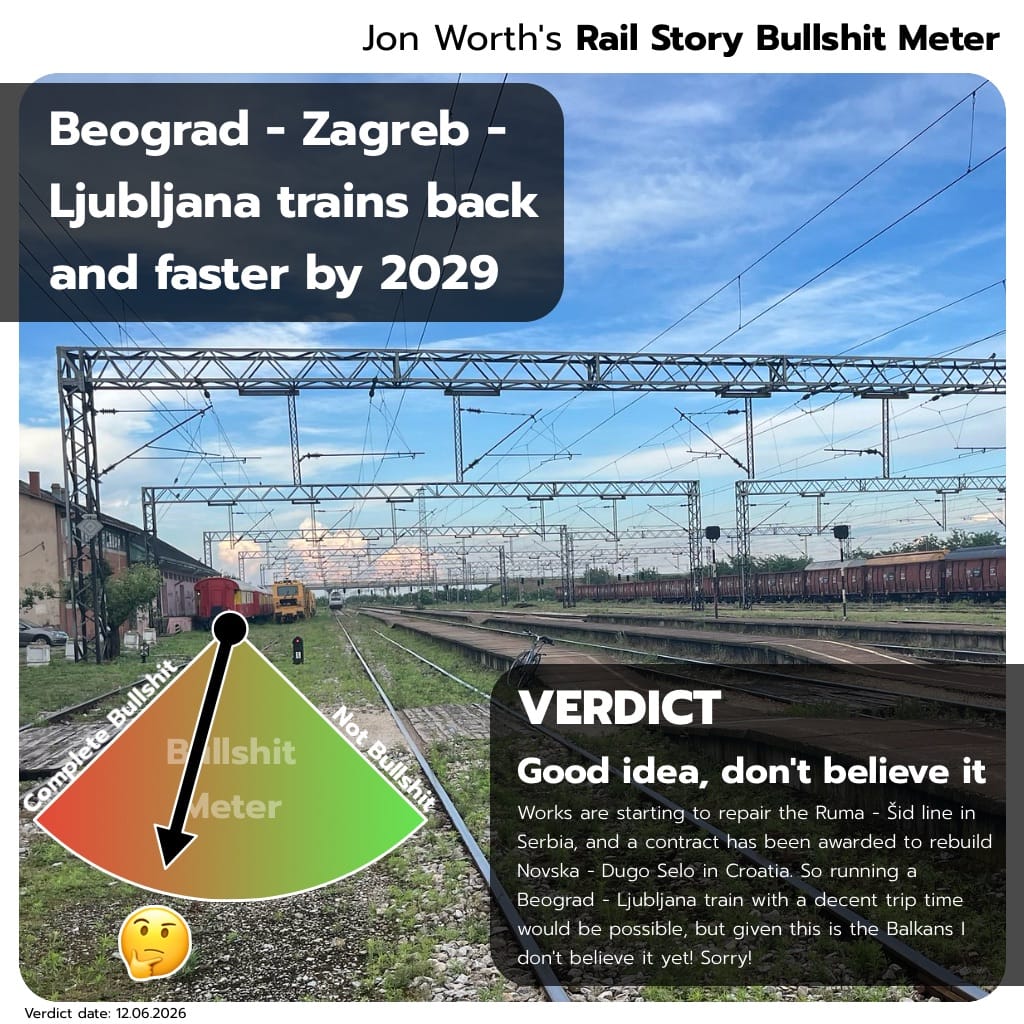
Bullshit Meter this week: Norway launches panoramic glass roof train
Good week: Poland and Germany sign a bit of paper (with a major omission)
Bad week: Stadler's complex delivery of Linz's tram-trains
Very bad week: Deutsche Bahn's works on Berlin-Hamburg delayed
In the media this week: The Europeans Podcast
Photo of the week: Kyrgyzstan's train to the sea
Calendar: Innotrans 2026


This is the fourth and last free edition of what will now become my subscriber-only newsletter that will be sent every Friday at 14:00 CET.

If you would like to continue receiving the newsletter from now on you will need to be a paid subscriber - it starts at just €3 per month, so less than €1 per newsletter.

What To Watch Out For Now

2026-Feb-20, Friday 08:10
[syndicated profile] political_betting_feed

Posted by CycleFree

It was late 2009. I was in the office of a senior trader.

I’d like to talk to you about XY.”

Ah yes. I wondered when someone would come and talk to me about that crook.”*

I remained silent.

He went on: “He runs a desk of crooks.

Three things to note about all scandals when they finally erupt.

  1. The first is this: “The real scandal is not that no-one knows. It’s that everyone knows.” Or could have known if they hadn’t taken steps to avoid knowing or asking questions. 

This statement was said about the children’s heart unit at Bristol Royal Infirmary in a report published in 2001 about events over a nine-year period between 1984 – 1995. Nine years: it doesn’t take much thought or imagination to realise how many people at all levels there must have been over such a period who knew or suspected that something was wrong. As at Bristol, so it is in most scandals since then, including those occupying so many column inches and pixels in recent days and doubtless many more. How many BBC journalists, for instance, were aware of the sex scandals involving their “talent”?

  1. When asked why, if they knew or suspected XY was a crook/sex offender/general low-life, they said or did nothing, the silence while they try to think of an answer that doesn’t make them look stupid / complicit / embarrassed can last an awfully long time. That senior trader finally responded by saying that he made sure to keep his clients away from the crook, evidently forgetting he was working for a corporate entity not himself, let alone his other legal/regulatory obligations.

Most of the time it comes down to the usual rationalisations: “I wasn’t sure / I didn’t have the evidence / More than my job’s worth / Not my job / I have a mortgage/family etc ., / No-one would believe me / I’d lose my job/be blamed etc.,.” It boils down in the end to a spectrum from wanting a quiet life to plain old lack of courage. It is all perfectly understandable, of course, but the more senior a person it is, the less acceptable it is. Or should be. If we want to delve into an earlier royal affair, ponder the words of Andy Webb, the journalist who uncovered the Panorama/Diana interview scandal and its cover up.

“It would have been a huge ask of the Head of a News Division, having recently seen the most famous, the most significant piece of news coverage in the Corporation’s history, having gone round the world, having won prizes and plaudits, how much moral courage do you need to pull the plug on the story …. by saying that it was gained through an egregious ethical breach? Who would have been brave enough to do that? It’s my feeling the bosses were not brave enough to do that and it prompted the cover up.”

Not brave enough.

That summarises what all inquiries have said and will say about why people did not act or speak up.

  1. Senior people who bore some responsibility will do their level best to present themselves as virtuous victims and/or brave seekers of the truth and/or lied to, hoping this will divert attention away from their own past actions and failures. See one G Brown, for instance. Or K Starmer. Or they will lie low – pretty much the entirety of Royal Mail/Post Office management when the unfounded prosecutions were actually happening, long before Ms Vennells appeared on the scene. Or they will be privately grateful that a suitable scapegoat has been found to embody the guilt of many. In the Epstein affair, the UK (with its perfect – quasi-Trollopian – mix of guilty female groomer, herself daughter of a crook, gay Minister labelled the Prince of Darkness and a former actual Prince, notable mainly for his libido, greed and stupidity) is the scapegoat. All the very many senior men in the US or elsewhere who abused girls, traded favours, misused confidential information and so on are unlikely to be investigated, let alone charged or face any accountability for their crimes and seedy revolting behaviour.

There will be much talk about taking such crimes seriously, about VAWG (a cliche now almost as pointless and irritations as “lessons will be learned” because in both cases nothing is ever done or was ever intended to be done), about not allowing the rich and powerful to use their wealth and law courts to stop the truth coming out, about getting justice for the victims and so on. 

Amongst this outbreak of public moral tut-tutting remember the following:

  • If raping trafficked women and girls is a no-no – and it is, then this applies to every man using a prostitute, since most of them have been trafficked and/or coerced. Even the dimmest men would have had plenty of evidence to put them on notice of this. How many men does that include and how many of them will face any accountability? 
  • It was barely a couple of weeks ago that the Scottish Parliament voted against a Bill to criminalise those buying sex (men) while decriminalising those who sell it (women).
  • Most men convicted of the possession of child abuse images, many of the very worst kind, never serve a prison sentence. It is not, of course, a victimless crime. Far from it. But it is one where the consequences for the perpetrator (and those who view are perpetrators at one remove) do not match the horror of what has been done to children.
  • The public inquiry into the abuse of girls by grooming gangs is proceeding very slowly indeed. 13 months after the Casey report was commissioned, the public inquiry’s Terms of Reference have finally been published in the last week.
  • The UK government has failed to take steps to stop the use of Slapps, used by the rich and powerful much like the libel laws as “a way of using power and money to silence legitimate journalism” (in the words of a former justice secretary).
  • The proposed Hillsborough law has been postponed for further drafting. Watch closely what happens to that law and what those amendments will mean.
  • The new Cabinet Secretary, Antonia Romeo, will be responsible for managing the process of disclosure of government documents relating to Mandelson to the Intelligence and Security Committee. This is not a court process. Control of information is a very powerful tool and one governments do not give up easily or at all. Another one to watch. 

Oh – and if any of these cases end up with criminal charges, the disclosure process will be a nightmare. Do not underestimate the capacity of the police and/or CPS to mess this up.** Royally.

* Mr XY continued working in the financial sector until 2023.

** I still bear the scars from the UK’s biggest fraud trial 12 years ago.

Cyclefree

[syndicated profile] tim_harford_feed

Posted by Tim Harford

Who will be the first to sail non-stop around the world? In 1968, The Sunday Times announces a trophy and a cash prize for the winner, and the Golden Globe Race is on.  Leading the charge are Robin Knox-Johnston, an old-fashioned British patriot, and Bernard Moitessier, an enigmatic French philosopher. As monstrous seas and deadly gales close in, the difference between victory and disaster will come down to just one word.  

For ad-free listening, monthly bonus episodes, monthly behind-the-scenes conversations, our newsletter, and more, please consider joining the Cautionary Club.

[Apple] [Spotify] [Stitcher]

Further reading

Stewart Brand’s new book is Maintenance: Of Everything. Robin Knox-Johnston gives his account of his voyage in A World of My Own, and Bernard Moitessier tells his story in The Long Way. Our two scripts on the Golden Globe race also relied on the books A Race Too Far by Chris Eakin, and A Voyage For Madmen by Peter Nichols.

[syndicated profile] skepchick_feed

Posted by Rebecca Watson

This post contains a video, which you can also view here. To support more videos like this, head to patreon.com/rebecca! Transcript: Today I want to talk about the upcoming mid-term election to decide who will represent Texas’s 31st Congressional District in the United States House of Representatives–not because this is a crucial race that we …
[personal profile] cosmolinguist

I thought I'd just get dropped off at the train station after our session (and the all-important debrief in Costa) was finished. But I should've known: my lovely colleague has sight loss herself and assured me that they -- she, her husband/PA, her guide dog -- would wait until I was safely on a train.

But first, I needed to pee, so I got directed to the gents' and I was only gone for a few minutes but when I walked back up the platform I saw those two (three, counting Flick the dog) standing with two other ladies chatting away. As I got closer I'd have guessed they were people R knew from work; one of them mentioned another charity that's known to us. I was happy to chill while they did that "Oh you know Nick?" kind of thing. But it turns out they didn't know each other; these women had just been at some sight-loss related event but one of them just spoke up when she saw the guide dog because she always does and is clearly the kind of person who'll talk to anyone. They had made friends at a local society for blind people, and had just come from, of all things, a funeral for someone they knew from that group. The chattier one told us about her eye condition, Homonymous Hemianopia -- and R and I said "that's the one we couldn't say before!" when we were going through a list of them at the session earlier; we both know about hemianopia but neither of us could get the word out at the time.

Then the other person said "And I have optic nerve hypoplasia."

And then I said "Shut up!" because I was so surprised. That's what I have! And even among other blind people, no one's heard of it. It's an odd, rare thing. I literally don't think I've ever met anyone else who's got it.

They and I ended up getting on the same train for the first 15 minutes or so, by which point the chatty one had made friends with the conductor and exchanged numbers with me.

My hypoplasia pal lives in Runcorn and says she comes to Manchester regularly; I said she should let me know if she wants to hang out.

Such a goofy coincidence, but an uplifting end to a day that could've gone better. (It was fine, it just...well, I'm too tired to explain it now. But it was fine. Just, could've been better.)

[syndicated profile] andrew_rilstone_feed

Posted by Unknown

In 1943, C.S Lewis published a series of four lectures on the subject of moral realism. His point of departure was a school textbook which he accuses of promoting moral relativism. To avoid upsetting its authors unduly, he refers to it as The Green Book. 

"The practical result of education in the spirit of The Green Book" he warns “Must be the destruction of the society which accepts it." 

[C.S Lewis, The Abolition of Man, page 1]

Readers may not be entirely surprised to learn that Lewis's Green Book and my Australian English Textbook are one and the same. The book is actually called The Control of Language, and the authors, who Lewis cryptically refers to as Gaius and Titus, were named Alec King and Martin Ketley. Both were British by birth and both were Oxford graduates; but both had spent their adult lives in Australia. King was a professor of English at Monash University near Melbourne; and Ketley taught English at a prestigious private school in Adelaide. 

Lewis's quarrel with King and Ketley may be fairly simply stated. According to Lewis, The Control of Language takes for granted that if you say that something is "pretty" you are not talking about the thing itself, but stating how you feel about it. If this is correct, then it must apply in all cases. Whenever we call something pretty or ugly or beautiful or good, we are only projecting our own emotions on to the object. "Murder is wicked" means no more than "I personally dislike murder" —no more, indeed, than "When I read about murder I experience feelings which I happen to dislike." So why not raise children to believe that murder is good? What is to stop future educators, if it ever becomes convenient, from training infants in such a way that they had beautiful, happy thoughts when they contemplated Jack the Ripper?

*

The first thing that Lewis takes issue with is Ketley and King's treatment of an anecdote concerning the romantic poet Samuel Taylor Coleridge. 

Here is Lewis's opening salvo: 

In their second chapter Gaius and Titus quote the well-known story of Coleridge at the waterfall. You remember that there were two tourists present: that one called it “sublime” and the other “pretty”; and that Coleridge mentally endorsed the first judgement and rejected the second with disgust.

[C.S Lewis, Page 1]

Here are King and Ketley themselves: 

This is a story told by Coleridge: he was standing with a group of tourists beside a waterfall, and, after a silence, one of the men in the party said, "That is sublime." Coleridge felt that “sublime" was exactly the right word. And then one of the women in the party added "Yes, it is pretty," and Coleridge turned away in disgust, feeling that "pretty" was exactly the wrong word.

[Alex King and Martin Ketley, The Control of Language, page 17]

Ketley and King have just introduced their readers to the distinction between reference and emotive meaning: that is the title of this second chapter. Reference is for them a technical word: they tell their students that it is part of an “official jargon”. They argue that expostulations ("wow!"), swearwords ("damn!") and gesture words ("good morning") have emotive meaning but no reference. Scientific and technical words, on the other hand, have reference but no emotive meaning, although they may acquire the latter with use. 

They then turn to a problematic case. There are, they think, two kinds of adjectives. Words like "big" and "green" have a reference: they refer to a quality in the object, and can therefore be judged "correct" or "incorrect". (It would be simply incorrect to say that the sky was green.) Words like  "pretty" and "good", on the other hand do not have a reference because they do not refer to a quality. You might think that I was wrong to say that the sky was beautiful today, but you couldn’t say that I was, in the defined sense, incorrect. The claim is that “sublime” and “pretty”  are in the second category. 

The waterfall story comes originally from Dorothea Wordsworth's diary: and her version differs substantially from King and Ketley's paraphrase. 

A lady and gentleman, more expeditious tourists than ourselves, came to the spot; they left us at the seat, and we found them again at another station above the Falls. Coleridge, who is always good-natured enough to enter into conversation with anybody whom he meets in his way, began to talk with the gentleman, who observed that it was a majestic waterfall. Coleridge was delighted with the accuracy of the epithet, particularly as he had been settling in his own mind the precise meaning of the words grand, majestic, sublime, etc., and had discussed the subject with William at some length the day before. 

“Yes, sir," says Coleridge, "it is a majestic waterfall." 

“Sublime and beautiful," replied his friend.

 Poor Coleridge could make no answer, and, not very desirous to continue the conversation, came to us and related the story, laughing heartily.

[Dorothea Wordsworth, Recollections of a Tour Made in Scotland, AD 1803, first published 1874. Second Week, Sunday August 21s.]

In this original version, it isn’t Coleridge who thinks the waterfall is sublime, it is the tourist. The lady doesn’t participate in the conversation; no one mentions the word “pretty”; and Coleridge isn’t disgusted with the tourist's opinion—he finds it funny.

Eighteenth and nineteenth century aesthetes spent a great deal of time worrying about the precise distinction between these kinds of words. Edmund Burke wrote an entire book, A Philosophical Enquiry Into the Sublime and Beautiful, explaining the distinction. This is why Coleridge laughs at the tourist's howler. He and William Wordsworth (the poet, Dorothea's brother) have spent all afternoon trying to establish a philosophical distinction between the very words which the tourist has used interchangeably. 

The disagreement, then, is about the use of language. Coleridge had been considering "the precise meaning of the words" and felt that the tourist had first of all chosen an "accurate epithet" to describe the waterfall. Ketley and King's "exactly the right word" is a perfectly good paraphrase. 

Why do the details of Ketley and King's version of the story differ from Wordsworth's original: and why doesn’t Lewis point this out? In 1909, an Oxford Poetry professor named A.C Bradley, had published an essay which, like Burke, sought to draw fine distinctions between words like  “pretty”, “beautiful” and “sublime”. Like Ketley and King, he takes the Coleridge story as his jumping off point: 

Coleridge used to tell a story about his visit to the Falls of Clyde; but he told it with such variations that the details are uncertain, and without regard to truth I shall change it to the shape that suits my purpose best.

[AC Bradley, Oxford Lectures on Poetry, “The Sublime”]

The "used to tell" part is a little puzzling. Coleridge died some twenty years before Bradley was born, so he can't be relying on oral testimony; but I can't track down any written source outside Dorothea Wordsworth's journals.  

After gazing at the Falls for some time, he began to consider what adjective would answer most precisely to the impression he had received; and he came to the conclusion that the proper word was “sublime”. Two other tourists arrived, and, standing by him, looked in silence at the spectacle. Then, to Coleridge's high satisfaction, the gentleman exclaimed, "It is sublime”. To which the lady responded, "Yes, it is the prettiest thing I ever saw”.

So Bradley also thinks that the story is about vocabulary. Coleridge is looking for the "precise" adjective; and the "proper" word. “Exactly the right word” would be another way of putting it. And the problem, again, is that the lady thinks she is agreeing with Coleridge. She thinks that “pretty” and “sublime” are synonyms; just as the man in the original story thought that “sublime” meant the same thing as “majestic”.  

It is worth summarising how the story mutates: 

What was Coleridge looking for?

Wordsworth: "The accuracy of the epithet" "the precise meaning of the word"

Bradley: "Which adjective would answer most precisely the impression which he had received" "the proper word"

Ketley/King: "Exactly the right word" 

What was the difference of opinion?

Wordsworth: "Yes, it is a Majestic waterfall" / “Sublime and beautiful."

Bradley: "It is Sublime" / "Yes, it is the prettiest thing I ever saw."

Ketley & King: "That is sublime" / "Yes it is pretty"

Lewis: "One called it sublime"/"The other called it pretty"

How did Coleridge react? 

Wordsworth: “He related the story, laughing heartily"

Bradley: “Her incapacity was ludicrous"

Ketley and King: “He turned away in disgust"

Lewis: “He rejected the judgment with disgust"

When Lewis says that the story of the waterfall is well-known, I think he means that Bradley's essay is well known. Very few general readers in 1943 would have been familiar with Dorothea Wordsworth’s journals; but Bradley's lectures would have been widely read. (His Shakespearean Tragedy is a standard work even today.) It seems clear that The Control of Language relies on Bradley’s lecture, not on Wordsworth’s diaries. (There are two tourists, the words at issue are pretty and sublime.) And it seems equally clear that Lewis is following King and Ketley without going back to Bradley. (Lewis says that Coleridge felt disgust, a word that Ketley and King have introduced.) 

But Lewis makes one substantive change to the story. The three other versions are agreed that the dispute is about vocabulary; about choosing “exactly the right word.” In Lewis’s version, what Coleridge disputes is the lady’s judgment. He thought, in King and Ketley’s sense, that she had said something incorrect. 

Here is the first part of Ketley and King's commentary on the  story. 

Why did Coleridge think the one word was exactly right, and the other exactly wrong? Obviously not because the one adjective described correctly, as we say, a quality of the water or the rocks or the landscape, and the other adjective described this quality incorrectly. It is not as if the man had said "That is brown" (referring, say, to the water) and the woman (also referring to the water) had added, "Yes, it is green”. No, Coleridge thought “sublime" exactly the right word, because it was associated in his mind with the emotion he was himself feeling as he looked at the waterfall in its setting of rock and landscape; and he thought "pretty" exactly the wrong word, because it was associated with feelings quite different from those he was actually feeling at the time, and with feelings that, to his way of thinking, no sensitive person would ever have while looking at such a sight.

[Page 17]

So: objects have qualities, such as size and colour; and statements about those qualities can be correct or incorrect. This is a perfectly coherent claim. If I said "the elephant is small" you might say that I was incorrect.  But if I said "the elephant is funny" you could only say that you disagreed with me; that the elephant was not funny to you. 

And here, I think, is the whole of Lewis's quarrel with the Green Book.

King and Ketley do not think that "prettiness" or "funniness" or "wonderfulness" or “sublimity" are (in their technical sense) qualities. Lewis thinks they are. King and Ketley think that "Elephants are big" and "Elephants are funny" are different kinds of statement. Lewis thinks they are statements of the same kind. 

Ketley and King equivocate on this point. When they first tell the story, they say that Coleridge felt that pretty was exactly the wrong word”. When they repeat it, they said that he thought that pretty was exactly the wrong word” and add that the lady’s feelings are feelings which to his way of thinking no sensitive person would ever feel.” If you are going to draw a philosophical distinction between thoughts and feelings, it would be better not to use “feel” as a synonym for “think”. 

And the anecdote is not, in fact, very apt for the point they are making. When philosophers and aesthetes wrote about sublimity, they did, in fact, write about emotion. According to Edmund Burke, humans have two basic needs—for sex and companionship, and for self-preservation. We have one set of feelings when we see an attractive lady (or, presumably, a handsome gentleman) and a different set of feelings when we see a ferocious tiger. Objects which are analogous to pretty ladies—flowers and birds and delicate paintings—make us feel nice feelings; big things like mountains and volcanoes and waterfalls that could potentially hurt us make us feel nasty feelings. But the sensations we experience when we look at a dangerous thing from a safe distance can, in fact, be pleasantly exciting or thrilling. Things which give us one kind of feeling (e.g oil paintings) we call “beautiful”; things which give us the other kind (e.g waterfalls) we call “sublime” 

This raises philosophical questions about whether we call objects sublime because we experience pleasantly terrifying sensations when we look at them; or whether we happen to experience pleasantly terrifying sensations when we look at things which have the innate quality of sublimity.  The hymn writer Joseph Addison argued that God so created humans that they would take pleasure in looking at things which did in fact have the quality of "beauty"—and would have had that quality even if no humans had ever existed to look at them. He thought that human beings were created to take pleasure in the contemplation of God, who is the biggest and most terrifying thing that it is possible to imagine; and that God kindly put waterfalls and volcanoes onto the earth as a means for them to experience an analogous numinous awe. 

Andrew Wilton’s catalogue for a 1981 exhibition called “Turner and the Sublime” is concerned with neither C.S Lewis nor S.T Coleridge, although it does contain several paintings of waterfalls. Quoting a 1805 essay by one Payne-Knight, he writes: 

“All sublime feelings are…feelings of exultation and expansion of the mind tending to rapture and enthusiasm.”  

[Andrew Wilton, Turner and the Sublime, p10.]*

Now, that is an interesting turn of phrase: “sublime feelings”. 

King and Ketley's second example (which Lewis doesn’t quote) makes their point rather more clearly. They ask the reader to compare the phrases "a big, red fire" and "a wonderful, beautiful fire”. Most of us would agree that “red” describes a quality that the fire itself may or may not have; but “wonderful” refers to the speaker's feelings about the fire. 

But they also acknowledge a difficulty. If I speak of a "wonderful fire" you will probably think of the kind of fire that you think that I would think is wonderful: say, one that's giving off a lot of heat, is under control and not too smoky. And you, like me, are very probably imagining a camp fire, complete with sausages, boy scouts and guitars. A 1940s Australian student would have been more likely to think of a roaring coal fire in a domestic house. If I were a psychotic arsonist (which, for the avoidance of doubt, I am not) then a "wonderful, beautiful fire" might mean something very different indeed! 

So, on King and Ketley’s terms, "wonderful" does have both a reference and an emotive meaning. If I call a horse "beautiful" I am probably saying that the horse has a set of measurable qualities that people who know about horses regard as desirable; and also that I myself am experiencing pleasure from looking at them. 

But now we come to a difficulty which has, I think, up to now been overlooked. King and Ketley say that when the lady declared the waterfall to be pretty, Coleridge “turned away in disgust”. And Lewis repeats this. Coleridge “rejected the judgement with disgust”. 

But disgust is an emotion. 

It is, in fact, a gut feeling. It bypasses the brain altogether. We don't feel disgusted by a pile of dog mess because we think it is unhealthy: if anything, we know that it is unhealthy because we find it physically repellent. It requires some intellectual effort to override the feeling: I feel that rotting food is disgusting, but I think that it is my duty to do the recycling and I believe I will suffer no ill-effect if I wash my hands afterwards. Dog owners and people with babies are particularly good at suppressing feelings of disgust towards human and animal waste. The feeling is distinct from the belief.

Do the authors of the Control of Language envisage Coleridge recoiling from the insensitive lady as he might have recoiled from something a cow had deposited in the adjoining field? Do they say "Coleridge appeared to be saying something about the lady's feelings towards the waterfall: really he was only describing the state of his own gut?" Come to that, does Lewis accuse them of reducing a subtle distinction between beauty and sublimity to the level of a nasty smell? Or did he think that the lady's aesthetic misjudgement had the objective quality of disgustingness in the same way the sky has the objective quality of blueness?

Lewis states that 

The reason why Coleridge agreed with the tourist who called the cataract sublime and disagreed with the one who called it pretty was of course that he believed inanimate nature to be such that certain responses could be more “just” or “ordinate” or “appropriate” to it than others. And he believed (correctly) that the tourists thought the same. The man who called the cataract sublime was not intending simply to describe his own emotions about it: he was also claiming that the object was one which merited those emotions.

[page 9]

But King and Ketley have stated: 

 Pretty was exactly the wrong word, because it was associated with feelings quite different from those he was actually feeling at the time, and with feelings that, to his way of thinking, no sensitive person would ever have while looking at such a sight.

[page 17]

How, exactly, do these claims differ? For King and Ketley, Coleridge felt disgust because he thought that what the lady felt about the waterfall was inappropriate. Lewis says that Coleridge and the tourist both believed that the waterfall was such that it deserved particular feelings more than others; that some feelings were “just” or “appropriate” and some were “unjust” and “inappropriate”.

I suppose “no sensitive person would have those feelings when looking at this thing” is a weaker claim than “this thing is such that those emotions are appropriate to it.” I suppose that “he felt this was the wrong word” and “to his way of thinking the feelings were wrong” are weaker claims than “the word and the feelings were in fact, objectively, wrong.” 

But it’s a very fine distinction: not one likely to lead to the end of human civilisation.

But C.S Lewis hasn’t yet deployed his biggest guns.

[*] The quotes from Addison also come from the Turner catalogue.


This is the first section of an ongoing critique of C.S Lewis's book The Abolition of Man. (I think that my essays should make sense if you aren't familiar with that tome.) This first section (which runs to six chapters) has already been published in full on my Patreon page, and the second section is being serialised there at present. 

Please consider joining the Patreon if you would like to read them, and to support the writer.


www.patreon.com/rilstone

The Big Idea: Gideon Marcus

2026-Feb-19, Thursday 18:55
[syndicated profile] scalziwhatever_feed

Posted by Athena Scalzi

On occasion, you know the ending of your story before you start writing. Most other times, you find the path as you go, each twisting turn appearing before you as you continue on your merry way. The latter seems to be the case for author Gideon Marcus, who says in his Big Idea that he wasn’t always sure how to wrap up his newest novel, Majera.

GIDEON MARCUS:

What’s the big idea with Majera? That’s a hard one, because there are lots of threads: the unstated, obvious, valued diversity of the future, which helps define the setting as the future. That’s a familiar technique—Tom Purdom pioneered it, and Star Trek popularized it. There’s a focus on relationships: found family, love in myriad combinations. There’s the foundation of science, a real universe underpinning everything.

But I guess what I associate with Majera most strongly is conclusion.

Starting an exciting adventure is easy. Finishing stories is hard. George R. R. Martin, Pat Rothfuss. Hideaki Anno all have famously struggled with it. When Kitra and her friends first got catapulted ten light years from home in Kitra, I started them on a journey whose ending I only had the vaguest outline of. I had adventure seeds: the failing colony sleeper ship in Sirena, the insurrection in Hyvilma, and the dead planet in Majera, but the personal journeys of the characters I left up to them.

I know a lot of people don’t write the way I do. I think writers mirror the opposing schools of acting: on one end, the Method of sliding deep into character; on the other, George C. Scott’s completely external creation of an alternate personality. In the Scott school of writing, characters are puppets acting out an intricate dance created by the author. In the Method school of writing, of which I am a member, the characters have independent lives. I know that seems contradictory—how can fictional agglomerations of words achieve sentience?

And yet, they do! I didn’t plan Kitra and Marta’s rekindling of their relationship. Pinky’s jokes come out of the ether. Heck, I didn’t even come up with the solution that saved the ship in Kitra—Fareedh and Pinky did (people often congratulate me on how well I set up that solution from the beginning; news to me! I just write what the characters tell me to…)

All this is to say, I didn’t know how this arc of The Kitra Saga was going to end. But I knew it had to end well, it had to end satisfyingly, for the reader and for the characters. There had to be a reason the Majera crew would stop and take a breather from their string of increasingly exotic adventures. The worldbuilding! All of the little tidbits I’d developed had to be kept consistent: historical, scientific, character-related. There had to be a plausible resolution to the love pentangle that the Majera crew found themselves in, one that was respectful to all the characters and, more importantly, the reader’s sensitivies and credulity.

That’s why this book took longer to put to bed than all the others. It’s not the longest, but it was the hardest. Frankly, I don’t think I could even have written this book five years ago. I needed the life experience to fundamentally grok everyone’s internal workings, from Pinky’s wrestling with being an alien in a human world, to Peter’s coming to grips with his fears, to Kitra’s understanding of her role vis. a vis. her friends, her crew, her partners. In other words, I had to be 51 to authentically write a gaggle of 20-year-olds!

Beyond that, I had to, even in the conclusion, lay seeds for the rest of the saga, for there is a central mystery to the galaxy that has only been hinted at (not to mention a lot more tropes to subvert…)

Conclusions are hard. I think I’ve succeeded. I hope I’ve succeeded. I guess it’s for you to judge!


Majera: Amazon|Amazon (eBook)|Audible|Barnes & Noble|Bookshop|Kobo

Author socials: Website|Bluesky

Cover Reveal: Monsters of Ohio

2026-Feb-19, Thursday 16:35
[syndicated profile] scalziwhatever_feed

Posted by John Scalzi

Just look at this cover for Monsters of Ohio. Look at it! It is amazing. I am so happy with it. It’s the work of artist Michael Koelsch (whose art has graced my work before, notably the Subterranean Press editions of the Dispatcher sequels Murder by Other Means and Travel by Bullet) , and he’s knocked it out of the park. I am, in a word, delighted.

And what is Monsters of Ohio about? Here’s the current jacket copy for it:

In many ways Richland, Ohio is the same tiny, sleepy rural village it has been for the last 150 years: The same families, the same farms, the same heartland beliefs and traditions that have sustained it for generations. But right now times are especially hard, as social and economic forces inside and outside the community roil the surface of the once-placid town.

Richland, in other words, is primed to explode… just not the way that anyone anywhere could ever have expected. And when things do explode, well, that’s when things start getting really weird.

Mike Boyd left Richland decades back, to find his own way in the world. But when he is called back to his hometown to tie up some loose ends, he finds more going on than he bargained for, and is caught up in a sequence of events that will bring this tiny farm village to the attention of the entire world… and, perhaps, spell its doom.

Ooooooooooh! Doooooom! Perhaaaaaaaps!

If that was too much text for you, here is the two-word version: Cozy Cronenberg.

Yeah, it’s gonna be fun.

When can you get it? November 3rd in North America and November 5 in the UK and most of the rest of the world. But of course you can pre-order this very minute at your favorite bookseller, whether that be your local indie, your nearby bookstore chain, or online retailer of your choice. Why wait! Put your money down! The book’s already written, after all. It’s guaranteed to ship!

Oh, and, for extra fun, here’s the author photo for the novel:

Yup, that pretty much sets the tone.

I hope you like Monsters of Ohio when you get a chance to read it. In November!

— JS

The paradox of work

2026-Feb-19, Thursday 16:52
[syndicated profile] tim_harford_feed

Posted by Tim Harford

In the late 1930s, the Roosevelt administration embarked on a curious project. Officials hired thousands of unemployed writers to produce guidebooks, children’s books, local histories, collections of folklore and a variety of other essays. Some of these writers were, or would become, American greats such as May Swenson, Ralph Ellison, Studs Terkel and Saul Bellow. Many others were more “writers” than writers: literate white-collar workers such as lawyers and librarians who were in desperate need of gainful employment.

This Federal Writers Project was just a tiny part of Roosevelt’s Works Progress Administration, which aimed to do much the same thing on a grander scale: find something useful for millions of unemployed Americans to do and pay them to do it. One of its outputs was American Life Histories, nearly 3,000 recollections of Americans, typically the elderly. Many of these were retellings of folk stories or local history, but about half were autobiographical. Venerable citizens reflected on their lives while being interviewed by a government-employed writer.

Even if the main goal of the project was to give literate workers something remunerative to do, the resulting archive — several million words — is fascinating: chapter-length stories of life in the late 19th and early 20th centuries. Some of the interviewees were born in slavery; some lived lives of hardship and violence; some had flourished.

Minnie Marshall told her interviewer that her father had died at sea before she ever knew him and her mother died when Minnie was 14. She married at 16, but her husband abandoned her — after knocking her front teeth out and taking all the money. At the age of 34 — although looking much older — Minnie worked as a maid, grinding out a living in New York City. “Whut ah’m gonna do? Ah got to live.”

Elmo Acosta had a more fortunate existence, interviewed at the age of 66 while working as a grocer in Jacksonville, Florida. Elmo had worked as city councillor and parks commissioner and proudly recalled his role in expanding the city’s parks, planting “holly, oak and magnolia trees as a memorial to the soldiers of the [first] World War” and making it possible to build a bridge across the river — the St Elmo Acosta Bridge is still standing.

Very different stories — and there are hundreds more in the archives. Last year three economists, David Lagakos, Stelios Michalopoulos and Hans-Joachim Voth, analysed these life histories with the goal of assessing what people had identified as significant or meaningful in their lives.

The received wisdom is that social connections are what make life worth living. Life gets its meaning from the quality of friendships, family ties and other social relationships.

American Life Histories suggests a slightly broader lesson. The stories people told about themselves, and especially the stories women told about themselves, did indeed often mention friends and family. But they also emphasised, over and over again, the importance of work as a foundation for a meaningful life.

Maybe this says something about the fact that the stories were collected against a backdrop of worklessness — not to mention as an antidote to it. But there is a more general lesson to be learnt about our puzzling relationship with work, and a lesson that will prove particularly useful if AI dislocates the labour market. The puzzle is that we have a love-hate relationship with working for a living. Look closely and you find that people do not tend to enjoy their work. Step back and you find that they can’t do without it.

Twenty years ago, a team of social scientists, including Alan Krueger, an economist, and Daniel Kahneman, a Nobel laureate psychologist, investigated the wellbeing of nearly 1,000 employed women living in Texas. Kahneman and Krueger asked these women to reconstruct a recent day, episode by episode, and to rate the emotions experienced during meals, stretches of childcare, commuting and so on. Emotional labels included “happy”, “enjoying myself”, “annoyed”, “depressed” and “anxious”.

A Douglas Adams character once ruefully reflected about his job that the hours were good but “most of the actual minutes are pretty lousy”. The point of Kahneman and Krueger’s research was to examine that distinction, directing people away from grand evaluations of their lives and towards the moment-to-moment experiences of which life is made.

Their day reconstruction method suggests that the three activities most likely to elicit positive emotions in these women were relaxing, socialising after work and, best of all, sex. The three most miserable activities were the evening commute, the morning commute and work itself. Work was simply the least enjoyable thing in their lives.

Yet to return to that puzzle, one of the most robust findings in social science is that when we ask people to evaluate their lives overall, there are few more reliable sources of dissatisfaction and disappointment than being unemployed. This isn’t just about money: the swings in life-satisfaction are much greater than income alone would explain.

Why is this? One revealing study conducted in Germany found that long-term unemployed people gave much more positive evaluations of their lives once they hit retirement age — presumably because unemployment signified failure or laziness, whereas retirement did not have the same stigma.

Another piece of evidence, from the UK, is that the psychic cost of being unemployed seems to be lower when regional unemployment rates rise: the more other people are unemployed, the less you look or feel bad for being unemployed yourself.

All this seems painfully relevant in a world where there is so much talk about artificial intelligence taking our jobs. Which is ironic, since Lagakos and his colleagues did not read millions of words of American Life Histories, nor even ask their research assistants to do so. Instead, they tweaked ChatGPT until it was delivering answers that were indistinguishable from human reviewers on a small subset of these memoirs. Then they unleashed the chatbot on the entire corpus.

American Life Histories began as a Depression-era make-work project for white-collar Americans and has been analysed by AI tools which were cheaper than human researchers, to produce the conclusion that work is profoundly important. If you don’t find that darkly funny, I’m sure we can ask ChatGPT to explain the joke.

Written for and first published in the Financial Times on 21 Jan 2026.

I’m running the London Marathon in April in support of a very good cause. If you felt able to contribute something, I’d be extremely grateful.

All Regulations Are Written in Blood

2026-Feb-19, Thursday 12:10
james_davis_nicoll: (Default)
[personal profile] james_davis_nicoll
TTRPG campaign idea.

PCs are field agents in charge of finding and dealing with arcane occupational safety violations. That six-sided summoning pentagram? Flagged. That storeroom where the universal solvent is next to the lemonade? Flagged.

That deadly-trap-filled dungeon abandoned by its creator when the maintenance fees got too high? Red tagged.

This isn't the same as my recent FabUlt campaign. That was about discouraging the worst excesses in a world run by oligarch mages and there weren't really regulations. This would be set in a regulatory state, and would be more an exploration of normalization of deviance.

£12 million pounds well spent

2026-Feb-19, Thursday 15:00
[syndicated profile] political_betting_feed

Posted by TSE

Andrew Mountbatten-Windsor arrested at Sandringham home

The Guardian (@theguardian.com) 2026-02-19T10:15:15Z

Breaking News: Andrew Mountbatten-Windsor, formerly known as Prince Andrew, was arrested in Britain on suspicion of misconduct in public office over his links to Jeffrey Epstein, the BBC said.

The New York Times (@nytimes.com) 2026-02-19T10:36:48.454859Z

A longstanding rule of this website is whenever the editor goes on holiday something major happens during that holiday and with my current holiday that rule continues. I am not sure what the dénouement of this story will be but it feels like an event that hasn’t happened in centuries, we’re used to First Ministers being arrested, we’re used to former cabinet ministers ending up in prison, but a (former) prince, nope?

The closest parallel I can think about is Sir Winston Churchill threatening to court-martial the Duke of Windsor, I suspect where Andrew Mountbatten-Windsor obtained the £12 million for his settlement with Virginia Giuffre will become a focus for the public and drag in the rest of the royals.

TSE

Site notice – I am currently on holiday until the 1st of March

Profile

matgb: Artwork of 19th century upper class anarchist, text: MatGB (Default)
Mat Bowles

September 2021

S M T W T F S
   1234
567 891011
12131415161718
19202122232425
2627282930  

Most Popular Tags

Style Credit

Expand Cut Tags

No cut tags
Page generated 2026-Feb-21, Saturday 03:02
Powered by Dreamwidth Studios